The Enochian language
What John Dee and Edward Kelley actually recorded, what the surviving manuscripts contain, and why the question "is it a real language?" has more than one honest answer.
This is outside research, not the library speaking. It was Assembled with Perplexity, an AI research tool, at the library's request, and it is published here as received, with only its formatting changed. The library did not write it and does not vouch for it.
What the library can check, it has checked, and the results are at the foot of the page whether they agree or not. Everything else is the note’s own claim, resting on its own sources.
It is here because the collection holds the primary material. The volumes this note bears on are listed at the end, and you can open every one of them.
Executive summary
Enochian is the modern name for an occult language recorded in the late sixteenth-century papers of the English mathematician, astrologer, natural philosopher, and occultist John Dee and his associate Edward Kelley. Dee generally called it "Angelical" or described it as a celestial language; the label "Enochian" became common later because the revelations were connected with the biblical patriarch Enoch. The surviving material is not a normal historical language community's complete linguistic record. It is a small, heterogeneous corpus embedded in a system of Renaissance angel magic, and its alleged supernatural origin cannot be established by historical or linguistic evidence.
The most useful way to understand Enochian is as three related bodies of material: the mysterious tables associated with Liber Loagaeth; the 21-character alphabet and magical names; and the translated invocations known as the Angelic Keys or Calls. The first body is largely uninterpreted, while the Calls provide the main material from which modern writers have attempted to infer grammar and vocabulary.
Historical setting
John Dee lived at the intersection of Renaissance science, mathematics, astrology, Hermetic philosophy, alchemy, Christianity, and occult practice. He believed that mathematical and magical correspondences could reveal the underlying order of creation, and he eventually sought direct angelic instruction. Dee is described as a mathematician, natural philosopher, and student of the occult who conducted séances with Edward Kelley, a convicted counterfeiter who acted as the medium or scryer.
The pair used a reflective stone or crystal, called a "shew-stone," during séances. Kelley reported seeing or hearing spiritual beings and relayed their messages while Dee recorded the sessions. Dee appears to have taken the project seriously, but the historical record cannot independently verify the entities Kelley claimed to perceive. The possibility that Kelley invented, improvised, or strategically shaped some of the material is therefore central to modern assessments of Enochian.
The relevant sessions began in the early 1580s. The British Library catalogue describes Sloane MS 3188 as containing Dee's records of conferences with angels from 22 December 1581 through 30 May 1583. Sloane MS 3189 contains Liber Mysteriorum Sextus et Sanctus, also called the Book of Enoch or Liber Loagaeth, transcribed by Kelley in 1583; from a substantial portion onward, it consists of letters and numbers arranged in 49-by-49 grids.
Why "Enochian"?
The name is retrospective. In Dee's own records, the language is associated with terms such as "Angelical," "Adamical," and the original language of creation. The later name "Enochian" reflects the claim that the patriarch Enoch had preserved or possessed ancient heavenly knowledge. Some modern accounts use "Enochian" for the entire system, but it is more precise to distinguish Dee's terminology from later occult usage.
This distinction matters because the language and the magical system are not identical. Enochian magic includes cosmological diagrams, divine and angelic names, ritual procedures, the Watchtowers, the Aethyrs, seals, tables, and invocations. The language is the verbal component of that larger system rather than an isolated language project.
The primary manuscript corpus
| Source | What it contains | Why it matters |
|---|---|---|
| Sloane MS 3188 | Dee's conferences with angels, chiefly covering 1581–1583 | Important record of the sessions and the emergence of the Angelical material |
| Sloane MS 3189 | Liber Mysteriorum Sextus et Sanctus or Liber Loagaeth, including large letter-and-number grids | Central to the "Book of Enoch" tradition; much of its content has no supplied translation |
| Sloane MS 3191 | Dee's notes on ceremonial magic, including the 48 Angelical Keys received in Kraków in 1584 | Main manuscript witness for the Keys and related magical material |
| Casaubon's 1659 publication | A True and Faithful Relation of Dee's conferences and spirits | Helped transmit the material to later readers, long after the original sessions |
The manuscript evidence is valuable even for readers who reject the supernatural explanation. It documents what Dee and Kelley wrote, how the material was organised, and how the language was embedded in a particular historical practice. It does not, by itself, demonstrate that angels supplied the text.
The alphabet and writing system
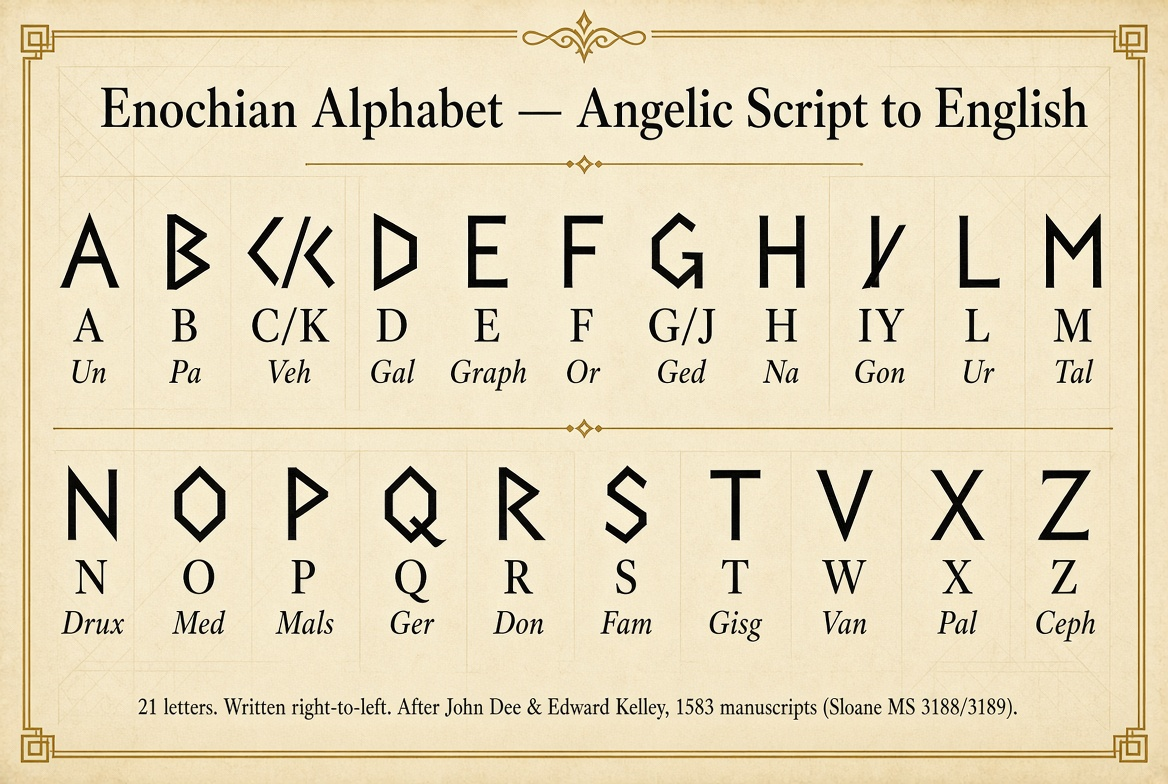
The Enochian alphabet is usually described as having 21 characters. It was presented as a distinct angelic script, although the surviving material was also written in Roman letters and transliterated by Dee or later editors. A particularly important scholarly observation is that the alphabet's inventory is not wholly alien: it can be understood as an alternative alphabetic system with a reduced letter inventory, rather than proof of a nonhuman writing technology.
In practical terms, the alphabet serves several roles. It is a visual emblem of the angelic system, a way to write names and words, and part of the ritual identity of Enochian magic. Modern fonts and pronunciation systems should not automatically be treated as direct recordings of an ancient or supernatural orthography; they are reconstructions and conventions based on the manuscripts and later interpretation.
The twenty-one letters
The alphabet is usually described as having twenty-one characters. It is not a one-to-one cipher of modern English: Dee mapped the letters onto twenty-two English letters by treating U and V as one character and omitting J, K and W. It is written right to left.
| Enochian name | English | Notes |
|---|---|---|
| Un | A | |
| Pa | B | |
| Veh | C / K | |
| Gal | D | |
| Graph | E | |
| Or | F | |
| Ged | G / J | |
| Na | H | |
| Gon | I / Y | a dotted form is sometimes used for Y |
| Ur | L | |
| Tal | M | |
| Drux | N | |
| Med | O | |
| Mals | P | |
| Ger | Q | |
| Don | R | |
| Fam | S | |
| Gisg | T | |
| Van | U / V | |
| Pal | X | |
| Ceph | Z |
There is no independent J, K or W. Those sounds are written with Ged, Veh and a doubled Van.
The sources given for this table are the letter-name lists derived from Sloane MS 3188 and 3189, where Kelley drew the alphabet on 6 May 1583, and Donald C. Laycock’s Complete Enochian Dictionary, the standard modern reference for the twenty-one-letter inventory.
The library cannot confirm any of this from its own shelf, and the check at the foot of this page shows why. Of the letter names that are not also ordinary English or Latin words, several appear nowhere in any of the eight Dee volumes here — including Casaubon’s 481-page printing of the conference records. That is not evidence the table is wrong. The alphabet chart is in the Sloane manuscripts, which Casaubon never printed and which this library does not hold. It means only that this section rests on its stated sources and not on anything a reader can open here, which is a weaker footing than the rest of the note stands on.
Liber Loagaeth
Liber Loagaeth is the most enigmatic portion of the corpus. The British Library description identifies it as the Book of Enoch and reports grids filled with letters and numbers, often in 49 rows by 49 columns. Unlike the Calls, it does not come with a straightforward, continuous English translation that would allow readers to verify its meaning sentence by sentence.
This creates a basic analytical problem: a grid of letters is not automatically a readable text. Without word division, punctuation, a demonstrated cipher procedure, or an independently confirmed translation, many interpretations remain possible. The tables may be treated as a magical artifact, a writing exercise, a cryptographic or combinatorial construction, improvised material, or an encoded text; the surviving evidence does not settle the question.
It is also important not to conflate Liber Loagaeth with the more grammatical-looking Calls. Scholarship and reference works sometimes use "Enochian" broadly for both, but they may represent different stages, functions, or compositional procedures within the Dee–Kelley material.
The Angelic Keys or Calls
The Keys are the most recognisable Enochian texts. The manuscript tradition contains material described as 48 Angelical Keys, while modern magical practice commonly speaks of 19 Calls or Keys. The apparent discrepancy reflects the organisation of the manuscript material and the later ritual system: the first 18 Calls are used in relation to the 30 Aethyrs through substitutions of names, while the 19th has a different role connected with the Watchtowers.
The Calls matter linguistically because they are accompanied by English renderings. Those glosses make it possible to compare recurring Enochian forms with proposed meanings, identify repeated sequences, and ask whether the texts display morphology and syntax. However, a translation supplied within a visionary or ritual process is not the same thing as an independently verified bilingual inscription. The English glosses may be free, expanded, or interpretive, which limits how confidently individual Enochian words can be analysed.
Is it a real language?
The answer depends on what "real" means. Enochian is unquestionably real as a historical corpus: people recorded it, manuscripts preserve it, and later practitioners used it. It is also reasonable to call it a constructed or invented language in the broad sense that its known textual history begins with a small group of human authors or transmitters rather than with a naturally developing speech community. What has not been demonstrated is its claimed angelic origin or its status as an independently existing natural language.
The linguistic evidence is mixed. Donald C. Laycock's influential analysis, associated with The Complete Enochian Dictionary, treated the material critically and emphasised that the corpus is small and difficult to interpret. Accounts of his analysis distinguish an early or first system, characterised by strong sound patterning and little translation, from a later or second system represented by the Calls and their English glosses.
Some features can look language-like: recurring forms, apparent verbal alternations, word-order patterns, and a vocabulary that can be aligned with translations. But the evidence is not strong enough to establish a complete grammar in the way that a large, independently documented human language would permit. The Calls are short, heavily constrained ritual texts, and a small corpus can make accidental regularities appear systematic.
A major criticism is that parts of the corpus exhibit unusually heavy repetition, rhyme, alliteration, and patterned sound sequences. Laycock's interpretation is that these features may resemble glossolalia — speech-like vocal production — or magical and poetic formulae more than ordinary language. This does not prove deliberate fraud, but it weakens claims that the material is a naturally evolved language.
Another issue is the relationship to English. Critical linguistic summaries report that the apparent syntax and some grammatical patterns are often close to English, while the vocabulary is mixed and the translation method is uncertain. That combination is compatible with an invented or improvised language shaped by an English speaker's linguistic habits. It is not compatible with the stronger claim that Enochian has been independently shown to be a wholly unrelated supernatural language.
Statistical analysis adds another caution. A quantitative study comparing Enochian material with the Voynich manuscript reported a very high proportion of words occurring only once in the Enochian corpus and argued that the pattern is unlike ordinary natural-language texts. Such results are relevant, but they do not by themselves identify the author's method or prove "gibberish"; they show that the corpus has unusual statistical properties and that its linguistic status remains unresolved.
Competing explanations
| Explanation | What it accounts for | Main difficulty |
|---|---|---|
| Angelic revelation | Dee's sincere religious interpretation, the ritual context, and the claim of a revealed alphabet | No independent evidence verifies angelic authorship |
| Kelley's deliberate invention | The dependence on a single scryer, the small corpus, and the possibility of improvisation | Does not automatically explain every regularity or Dee's sustained commitment |
| Glossolalia or trance speech | Repetition, sound patterning, and the fluency of some passages | Does not fully explain why some material appears to have translations and recurring morphology |
| Deliberate constructed language | The existence of recurring forms and a ritual vocabulary | The corpus is too small and inconsistent to reconstruct a complete grammar with confidence |
| Cryptographic or combinatorial text | The grid structure and unusual arrangements in Liber Loagaeth | No generally accepted decipherment or independently confirmed plaintext exists |
The most defensible historical conclusion is modest: Dee and Kelley produced or transmitted a body of occult-language material in a visionary setting, and later practitioners systematised it. The evidence permits study of its manuscripts, sounds, forms, and cultural afterlife; it does not compel acceptance of its supernatural explanation.
Later reception
The material did not become a major public language immediately after Dee's lifetime. Its later visibility was aided by the preservation and publication of Dee-related manuscripts, especially the 1659 edition associated with Meric Casaubon. In the nineteenth century, the Hermetic Order of the Golden Dawn incorporated Enochian material into a more elaborate ritual framework, helping define the form familiar to many modern occultists.
Aleister Crowley and later ceremonial magicians further popularised the Calls, pronunciation conventions, and Aethyr system. Modern Enochian practice therefore has to be separated into at least two layers: the sixteenth-century documents, and the interpretations, ritual arrangements, and theological claims added by later occult movements.
How to study it responsibly
A practical study method is to begin with the manuscripts and catalogue descriptions, then compare diplomatic transcriptions with later dictionaries and ritual editions. Treat every proposed English meaning as a hypothesis tied to a particular gloss, not as a universally settled dictionary definition. Keep Liber Loagaeth, the alphabet, the Calls, and later Golden Dawn or Crowley materials in separate analytical buckets.
For a software-minded investigation, the corpus can be modelled as a small annotated dataset: preserve the manuscript witness, folio or page, transcription, word boundaries, proposed translation, and later editorial changes as separate fields. Frequency analysis, n-gram comparison, repeated-sequence detection, and alignment between Enochian forms and English glosses can test claims about regularity. Such experiments can reveal patterns, but they cannot independently determine whether a text was angelically revealed, consciously invented, improvised, or produced through a mixture of methods.
Final assessment
Enochian is best understood as a historically documented occult language system, not as a proven ancient or extraterrestrial language. Its importance lies in the unusual combination of Renaissance intellectual history, manuscript culture, visionary practice, constructed-language formation, and modern esoteric reception. The language-like portions have enough recurring structure to justify serious analysis, but the corpus is too small, the translations too uncertain, and the origin claims too unverified to support confident claims of a complete natural language or supernatural revelation.
What the library could check
Whole-word counts in the library’s own copy of True and Faithful Relation of What Passed for Many Yeers Between Dr John Dee and Some Spir, John Dee:
Whole-word counts in these 8 volumes (337, 143, 259, 264, 280, 312, 035, 053):
The volumes this rests on
11 of them are in this library and free to read.
- True and Faithful Relation of What Passed for Many Yeers Between Dr John Dee and Some SpirJohn Dee · 481pp · Esoteric & Occult
- The Calls of EnochJohn Dee · 15pp · Esoteric & Occult
- Compendium Heptarchia MysticaJohn Dee · 37pp · Esoteric & Occult
- De Heptarchia MysticaJohn Dee · 34pp · Esoteric & Occult
- The Hieroglyphic Monad (illustrated edition)John Dee · 47pp · Symbols & Sacred Signs
- Hieroglyphic MonadJohn Dee · 46pp · Symbols & Sacred Signs
- Private Diary of Dr John DeeJohn Dee · 142pp · Esoteric & Occult
- John Dee (1527-1608)Charlotte Fell Smith · 157pp · Esoteric & Occult
- Enochian Magick ReferenceBenjamin Rowe · 34pp · Esoteric & Occult
- The Book of Enoch the ProphetRichard Laurence · 399pp · Apocrypha
- The Book of EnochR. H. Charles · 121pp · Apocrypha